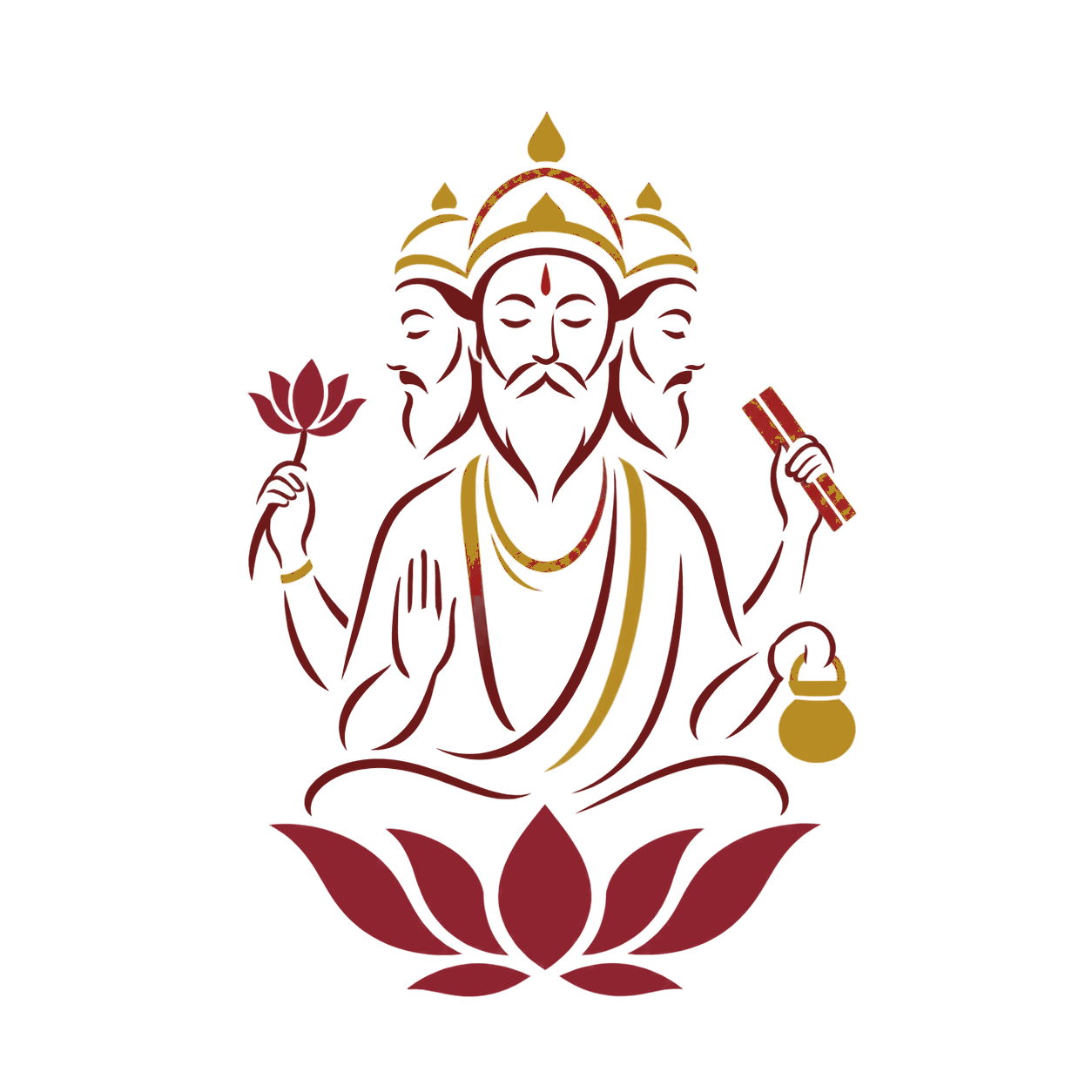
The origin of the temple
The Brahma Temple stands on the banks of the Bharathappuzha (Nila) at Tavanur in Malappuram district. In old records the temple is known as “Mannil Thrikkovil”. Tavanur's old name was “Thapasanur” – the land of ascetics.
According to legend, Parasurama, who reclaimed Kerala from the sea by throwing his axe from Gokarna, gave that land to the Brahmins. To purify the new land, he began a great yagam at Thirumoorthimala in the presence of the Trimurthis. But the yagam could not be completed.
When Parasurama asked why, the Saptarishis told him that the yagam must be held at Thapasanur, where the Adiparashakthi is present. The place where Lord Brahma, who presided over the yagam, sat is today's Brahma Temple. Lord Vishnu, who came for the yagam, resides with Lakshmi across the river as Navamukunda at Thirunavaya, and Lord Shiva resides with Parvathi at the nearby Mahadeva temple.
The Brahma Temple, the Navamukunda Temple and the Mahadeva Temple stand like a triangle around the Bharathappuzha.
Why Brahma temples are rare
The reason lies in a story from the Shiva Purana. Brahma and Vishnu set out to find the beginning and end of the Shiva Linga – Brahma upwards and Vishnu downwards. Neither could find it. But Brahma, citing a Ketaki flower that had fallen from Shiva's head as his witness, falsely claimed he had seen the top. Shiva removed the head that had lied, and so Brahma, who once had five faces, became four-faced. Truth is eternal; untruth does not last – this is the message of the story. Brahma was also cursed to go without worship for centuries.
That is why temples where Lord Brahma receives daily worship are so rare in India. The Tavanur Brahma Temple is one of the two Brahma temples in India – the other is at Pushkar in Rajasthan. It is the only Brahma temple in South India.
Tavanur Mana and the urayma
For centuries the urayma (hereditary ownership) of the temple has belonged to Tavanur Mana. The family belongs to the Bhargava (Parasurama) gotra, and this link with Parasurama may be why the temple came into their care.
Tavanur Mana was one of the eight illams entitled to perform the Ariyittuvazhcha (coronation) of the Zamorins. Since the time of the Cheraman Perumals, the elders of the Mana also held the title “Chumaran” (Deshachumaran, Kottachumaran). Several temples, including the Vaishravana temple, were granted to the Mana by the Raja of Vettathunad, and the Mana also had a respected role in the Maghamakam.
During Tipu's invasion, temples in the area, including Thirunavaya, were damaged, but the Brahma Temple remained safe. Elders say the Muslim neighbours of the region stood guard over the Mana and the temple – a great example of the communal harmony of this land.
The Bharathappuzha and the seven rivers
During Parasurama's yagam, when Goddess Saraswathi, the wife of the presiding priest, could not arrive in time, Goddess Gayathri sat beside Brahma. Seeing this, an angry Saraswathi cursed Gayathri to become a river, and Gayathri cursed her in return. So were born the Gayathripuzha, and the “Prathichi” river in which Lakshmi and Parvathi flowed together with Saraswathi. Together they form the Bharathappuzha.
It is believed that all seven sacred rivers of India – Ganga, Yamuna, Godavari, Saraswathi, Narmada, Sindhu and Kaveri – are present here; this is the meaning of the name “Bharathappuzha”. Rites performed here, including bali tharpanam, are believed to grant moksha.
The Maghamakam, the worship of these river goddesses, later grew into the Mamankam, where the Chera, Chola and Pandya kings gathered. The Mamankam ended after the Mysore invasion and British rule.
The temple structure
The oldest structure in the temple is Lord Brahma's round sreekovil (vatta sreekovil). Round sreekovils of this kind are believed to be thousands of years old.
Standing in the Bharathappuzha, one feels that the idol is almost in the middle of the river; the river may once have flowed this way. When the changing course of the river damaged parts of the temple, Tavanur Mana built stone walls and steps around it about 300–400 years ago to protect it.